
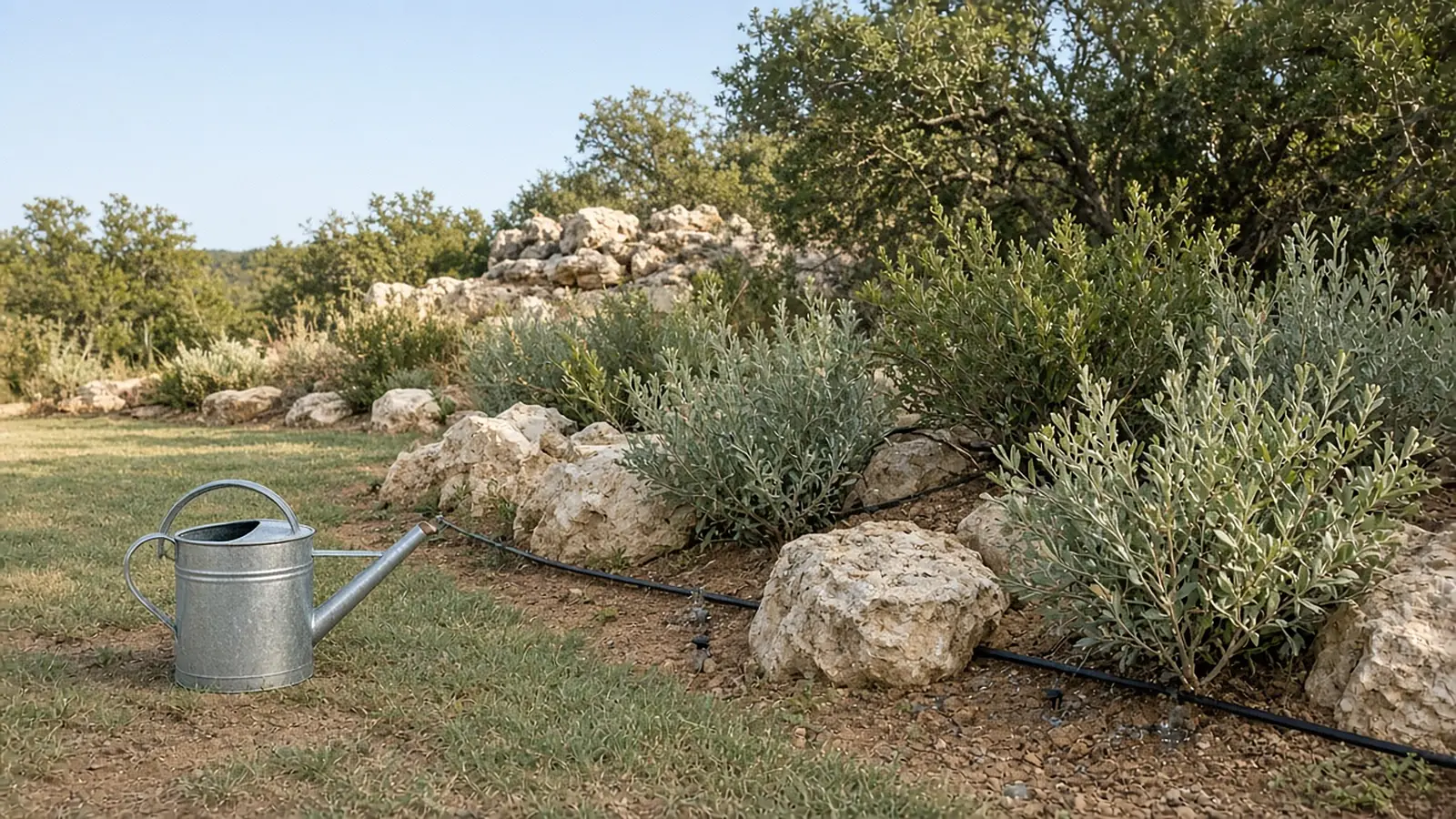
Watering natives under local drought rules
In the Canyon Lake / Comal County area, the schedule you may legally water on is set by your water provider, not by a single county-wide clock, and not by the Edwards Aquifer Authority’s pumping stages. This guide records what those agencies had published as of 21 November 2026 (America/Chicago). Stages change. Read the live page on your own bill before you change a sprinkler clock or plant a new lawn.
It is written from ZIP 78133, Canyon Lake. Many homes around the lake are served by Texas Water Company, the utility formerly known as Canyon Lake Water Service Company and SJWTX. That is not every address. Some nearby subdivisions are Guadalupe-Blanco River Authority (GBRA) retail customers. Some properties are on other systems or private wells. If you are not sure, look at your water bill.
Who actually sets your watering rules
- Texas Water Company (TWC) publishes Comal County drought-stage watering rules for its retail customers, including systems named in its 2025 drought contingency plan such as Canyon Lake Shores (PWS ID 0460019) and other Comal and Blanco County systems listed in that plan. [1] [2]
- GBRA sets retail drought stages only for the retail communities it names: Cordillera Ranch, Johnson Ranch, and Comal Trace. [3] [4]
- Edwards Aquifer Authority (EAA) has jurisdiction in all of Bexar, Medina, and Uvalde counties and in portions of Atascosa, Caldwell, Comal, Guadalupe, and Hays counties. It regulates Edwards well owners with withdrawal permits. EAA’s own page says it “does not enforce lawn watering activities or other general water limitations” and that “any enforcement of such activities or limitations is enforced by a municipality.” Residents and businesses who receive water from a public water system “should follow their respective water providers’ directives.” [5]
TWC’s 29 October 2026 customer update also notes that not all of its customers receive water from Canyon Lake: the company uses both surface water and groundwater, and drought-stage decisions are not based on lake level alone. [6]
What Texas Water Company was posting on 21 November 2026
On 21 November 2026, TWC’s Comal County drought-conditions page stated, under “Current Drought Conditions,” that landscape watering done by automatic, in-ground, or sprinkler systems, hand watering, soaker hose, bucket, and/or drip irrigation is allowed once every other week from 7:00 a.m. to 10:00 a.m. or 7:00 p.m. to 10:00 p.m., with watering days determined by the last digit of the address. [2]
That every-other-week schedule is the watering frequency TWC publishes for both Stage 2 and Stage 3. The “Current Drought Conditions” block, as fetched that day, stated the schedule but did not print the words “Stage 3” in the same block. A TWC article dated 29 October 2026, still on the company’s site, said Stage 3 drought restrictions were in place and that “the operational criteria needed to move out of Stage 3 have not yet been fully met,” even though Canyon Lake levels had improved. That article also said restrictions are not determined by lake levels alone. [6]
This guide therefore reports both: the 21 November schedule on the drought-conditions page (once every other week, in those hours, by address), and the 29 October article’s Stage 3 statement. It does not invent a stage number beyond what those pages printed. Check the live drought-conditions page for the stage in effect the day you water.
Texas Water Company’s published stage rules
The following comes from TWC’s Comal County drought-conditions page and, where noted, from the 2025 Drought Contingency Plan. Hours in Stages 0–3, on that public page, are 7:00 a.m. to 10:00 a.m. or 7:00 p.m. to 10:00 p.m. The public page applies that window to automatic or in-ground sprinklers, hand watering, soaker hoses, buckets, and drip irrigation alike. [2] [1]
| Stage | How often | Address ending 0, 2, 4 | 1 or 3 | 6 or 8 | 5, 7, or 9 |
|---|---|---|---|---|---|
| Stage 0 (year-round unless a drought stage is declared) | Two days per week | Even last digits (0, 2, 4, 6, 8): Monday and Thursday | Odd last digits (1, 3, 5, 7, 9): Tuesday and Friday | ||
| Stage 1 | Once a week | Monday | Tuesday | Thursday | Friday |
| Stages 2 and 3 | Once every other week | Monday | Tuesday | Thursday | Friday |
| Stage 4 | The public page says rules prohibit all outdoor water use. | ||||
The public page says that if there is no street address, watering days are Monday and Friday in Stage 0, and Monday in Stages 1–3. [2]
Stage 3, on that same page, uses the Stage 2 watering schedule, with additional restrictions that “may apply (i.e., installation and filling of swimming pools, car washing, and pressure washing).” The 2025 plan is more specific on those extras: filling of swimming pools is prohibited, but customers may top off pools (public/community pools may be exempt to maintain safe water quality); car washing is only allowed at commercial car washes that recycle water; pressure washing is prohibited except for health and safety, and then only with a nozzle that does not use more than 3.5 gallons per minute and has a trigger shut-off. [2] [1]
New sod and landscaping variances
TWC’s Comal County drought-conditions page states that variance requests for new sod and/or landscaping will not be approved in Stage 2, Stage 3, or Stage 4. [2]
The 2025 plan also says landscape variances may be available in limited circumstances when criteria are met: a current backflow-device inspection and a completed customer service inspection, with variances allowing daily watering between 7:00–10:00 a.m. or 7:00–10:00 p.m. for up to two weeks. [1] The public stage page is the stricter, stage-specific statement about new sod and landscaping in Stages 2–4. This guide reports both and does not tell you a variance will be granted. If you are on TWC and considering a new lawn during an every-other-week or no-outdoor-water stage, get the answer from TWC before you buy plant material.
GBRA retail customers (only some communities)
GBRA’s retail-customer and drought pages name retail customers as residents in Cordillera Ranch, Johnson Ranch, and Comal Trace. Those pages are not a watering schedule for every Canyon Lake or Comal County address. [3] [4]
On 21 November 2026, GBRA’s retail-customer page showed the current retail stage as Non-Drought, with the statement that no restrictions were currently in effect, that recent rainfall had improved conditions, and that Canyon Reservoir was in a non-drought stage. The same page said a tiered water rate structure implemented in May 2026 remains in effect. [3]
On that non-drought conservation page, GBRA still encourages conservation and includes a “How Often to Water” table for common turf species. Buffalograss is listed as every 2–5 weeks; bermudagrass and zoysia every 7–10 days; St. Augustine every 5 days, with a note that St. Augustine requires substantially more water than other turf options “and is not recommended for landscapes in our region.” General outdoor tips on the same page include watering in the early morning or evening, not watering on windy days, and not over-watering. [3]
If your community is one of those three GBRA retail systems, follow GBRA’s current stage page, not TWC’s. If it is not, do not assume you may water on a non-drought schedule just because Canyon Reservoir is full.
Edwards Aquifer Authority — pumping cuts, not lawn schedules
EAA’s Critical Period Management plan reduces how much permitted Edwards groundwater users may pump during drought. It applies to Edwards well owners and permit holders authorized to pump more than three acre-feet annually, including utilities that pump Edwards water for their customers. [5]
That is not a lawn-sprinkler ordinance for the public. EAA says it does not enforce lawn watering and that people who get water from a public system should follow their provider. Parts of Comal County are in EAA’s jurisdiction; that still does not make an EAA stage into a TWC or GBRA watering day. [5]
EAA’s CPM page, as checked on 21 November 2026, stated that the San Antonio Pool (which includes Comal County among the listed counties) was in Stage 2, with a 30% pumping reduction for affected permit holders, and that the page was last updated 21 November 2026. [5] A 6 November 2026 EAA press release had announced a return to Stage 2 effective 3 November 2026 after the J-17 10-day average rose above the Stage 2 threshold. [7] Those figures describe permit reductions, not your watering day.
A note on SAWS (usually not Canyon Lake)
San Antonio Water System watering rules apply to SAWS customers. They are included here only so a Hill Country reader who is actually in the SAWS system does not confuse them with TWC or GBRA rules, and so a 78133 reader does not follow them by mistake.
A SAWS news release dated 20 November 2026 said SAWS will end Stage 3 watering rules effective Monday, 23 November 2026, and that Stage 2 rules will take effect at that time. Under those Stage 2 rules, landscape watering with an irrigation system, sprinkler, or soaker hose is permitted once a week between 5 and 10 a.m. and 9 p.m. and midnight on a day based on the last address digit, and watering with a hand-held hose is allowed at any time on any day. [8] [9] Those hours and the hand-held-hose exception are SAWS rules, not TWC rules. TWC’s public Comal County page applies the same 7–10 a.m. or 7–10 p.m. window to hand watering and drip as to sprinklers. [2]
What that means for buffalo grass and native plants
Start with the legal schedule for your provider. Then use the plant sources to decide how much of that allowed window an established native yard actually needs.
- AgriLife ranks buffalograss “excellent” in drought tolerance, tells homeowners to water deeply and then wait for drought-stress symptoms rather than watering on a fixed weekly habit, and also warns that buffalograss is easily invaded by weeds when watered excessively. [10] [11]
- The Wildflower Center profile says buffalograss requires only one and a half inches of rain per month to stay green and will go dormant during droughts and in winter. [12] A 22 April 2007 Wildflower Center Q&A used a different summer figure: 1 to 1.5 inches of water per week to keep buffalograss green, while stating that established buffalograss will survive summer droughts without supplemental water and will go dormant. [13] Those two figures are quoted, not averaged.
- GBRA’s conservation table (for its retail customers) lists buffalograss at every 2–5 weeks. [3]
- For new seed or sod, AgriLife says the first weeks require frequent moisture. [14] That horticultural need may not be legal to meet if your utility is in a stage that limits watering to every other week — or bans outdoor watering — and is not granting new-landscape variances. TWC’s public page says those variances will not be approved in Stages 2–4. [2]
- The Wildflower Center’s cenizo profile says that, as with any shrub or tree, the first year requires regular deep watering for root establishment, and that once established, cenizo does not require fertilization or watering beyond average rainfall. It also says the best time for planting most shrubs and trees is the dormant period of fall and winter. [15] First-year shrub watering still has to happen inside your utility’s allowed days and hours.
A practical reading of those sources, without inventing a new number, is: an established buffalo grass lawn and established low-water native shrubs are a better match for every-other-week (or less) watering than a grass AgriLife or GBRA describes as needing much more frequent irrigation. New plantings are the hard case, and the hard case is why planting date and drought stage have to be decided together.
Sources
- The Texas Water Company DBA SJWTX, Drought Contingency Plan and Emergency Conditions (2025). https://www.txwaterco.com/media/rvairnvw/twc_final-2025-main-drought-contingency-plan.pdf
- Texas Water Company, “Comal County Drought Conditions,” checked 21 November 2026. https://www.txwaterco.com/water-conservation/drought-management/comal-county-drought-conditions/
- Guadalupe-Blanco River Authority, “Retail Customers,” checked 21 November 2026. https://www.gbra.org/retail-customers/
- Guadalupe-Blanco River Authority, “Drought/Conservation.” https://www.gbra.org/news/drought/
- Edwards Aquifer Authority, “Critical Period/Drought Management (CPM),” checked 21 November 2026. https://www.edwardsaquifer.org/groundwater-users/critical-period-drought-management/
- Texas Water Company, “The Water Source: Oct. 29, 2026.” https://www.txwaterco.com/our-company/community-news/the-water-source-oct-29-2026/
- Edwards Aquifer Authority press release, “Recent Rains Improve Aquifer levels and prompt return to EAA Stage 2,” 6 November 2026. https://www.edwardsaquifer.org/wp-content/uploads/2026/11/Recent-Rains-Improve-Aquifer-levels-and-prompt-return-to-EAA-Stage-2.pdf
- San Antonio Water System, “Rising Aquifer Levels Prompts Return to Stage 2 Watering Rules,” 20 November 2026. https://www.saws.org/rising-aquifer-levels-prompts-return-to-stage-2-watering-rules/
- San Antonio Water System, “Stage 2” watering rules. https://www.saws.org/conservation/drought-restrictions/stage-2/
- James McAfee, Texas A&M AgriLife Extension, Lawn Water Management, SCSC-PU-066, June 2006. https://mytexas.ag.tamu.edu/wp-content/uploads/2026/03/lawn-water-management.pdf
- Texas A&M AgriLife Extension, Turfgrass Selection for Texas. https://mytexas.ag.tamu.edu/wp-content/uploads/2026/03/turfgrass-selection-for-texas.pdf
- Lady Bird Johnson Wildflower Center, Bouteloua dactyloides. https://www.wildflower.org/plants/result.php?id_plant=boda2
- Lady Bird Johnson Wildflower Center, Mr. Smarty Plants, 22 April 2007. https://www.wildflower.org/expert/show.php?id=1169
- Texas A&M AgriLife Extension, Turfgrass Establishment for Texas, SCSC-PU-079. https://mytexas.ag.tamu.edu/wp-content/uploads/2026/03/turfgrass-establishment-for-texas-ecological-turf-tips.pdf
- Lady Bird Johnson Wildflower Center, Leucophyllum frutescens (cenizo). https://www.wildflower.org/plants/result.php?id_plant=LEFR3