
Native trees for Hill Country yards
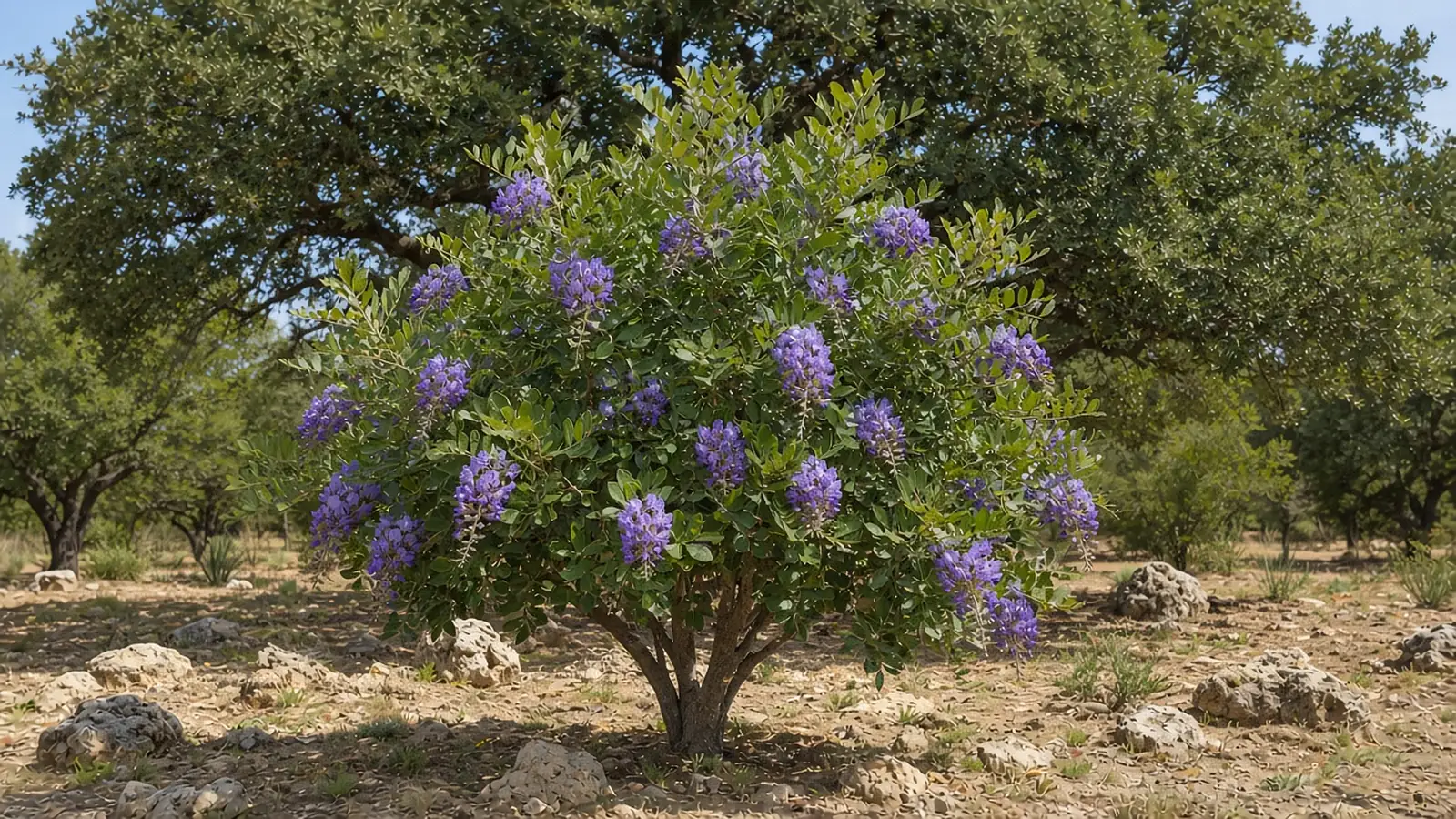
This guide starts with Texas mountain laurel (Dermatophyllum secundiflorum), an evergreen shrub or small tree that is already a Hill Country favorite, then covers other woody natives whose Lady Bird Johnson Wildflower Center profiles and Texas A&M AgriLife Extension lists support their use on limestone in Central Texas: escarpment live oak, Texas redbud, cedar elm, Mexican plum, possumhaw, and Texas persimmon. It is written from Canyon Lake in Comal County (ZIP 78133). It is not a complete Hill Country tree flora, and it does not invent sizes, watering rules, or planting dates that those sources do not give.
A Wildflower Center “Hill Country Horticulture” special collection of more than 430 species native to central Texas is a place to keep looking after this short list. The Center also publishes a Central Texas recommended-species collection for planned landscapes. [1] [2]
How this list was chosen
Each tree below has a Wildflower Center native-plant profile that places it in central Texas, on the Edwards Plateau or limestone soils, or — for possumhaw — documents a herbarium specimen from Comal County. Most also appear on Texas A&M AgriLife Extension’s 2009 recommended landscape-plant list for neighboring Williamson County, which marks Texas natives with an asterisk. [3]
A 2011 Wildflower Center answer about trees for rocky caliche soil in northwest Austin recommended, among others, escarpment live oak, cedar elm, Texas redbud, Texas mountain laurel (listed there as Sophora secundiflora), and Mexican plum, and it flagged oak wilt on live oak and Texas red oak. That answer is used here as a Central Texas landscape recommendation, not as a substitute for the species profiles. [4]
Texas mountain laurel is also covered in Top native shrubs for the Hill Country, because the Center treats it as both a shrub and a small tree. The profile facts below are the same source, written here with the yard-tree questions in mind.
At a glance
| Plant | Usual size (from the profile) | Light | Water use | Leaf habit | Deer resistance (Center’s term) |
|---|---|---|---|---|---|
| Texas mountain laurel, Dermatophyllum secundiflorum | Usually 10–15 ft; can exceed 30 ft | Sun or part shade | Low or medium | Evergreen | High |
| Escarpment live oak, Quercus fusiformis | 20–40 ft | Sun or part shade | Low | Semi-evergreen (tardily deciduous) | Not stated |
| Texas redbud, Cercis canadensis var. texensis | 10–20 ft | Sun or part shade | Low or medium | Deciduous | Moderate |
| Cedar elm, Ulmus crassifolia | Size notes 30–60 ft; opening description 50–70 ft high and 40–60 ft wide | Part shade | Medium | Deciduous (see note in section) | No |
| Mexican plum, Prunus mexicana | Up to about 35 ft, often much shorter | Sun or part shade | Low | Deciduous | No |
| Possumhaw, Ilex decidua | 15–30 ft; size notes up to about 30 ft | Sun or part shade | Medium | Deciduous | Moderate |
| Texas persimmon, Diospyros texana | Normally 10–15 ft; can be much taller | Sun or part shade | Low | Deciduous or semi-evergreen | Moderate |
Texas mountain laurel
Dermatophyllum secundiflorum (formerly Sophora secundiflora) is an evergreen, usually multi-trunked shrub or small tree. The Wildflower Center says its usual height at maturity is 10–15 feet, though it can be only a few feet tall or more than 30 feet; the size notes say up to about 30 feet, usually much shorter. It has dense, dark green, glossy compound leaves of 7–9 shiny, leathery leaflets, and showy, fragrant bluish-lavender flower clusters, 3–7 inches long, in February, March, and April. The fragrance is often compared to artificial grape products, and the Center calls it pleasant but almost overpoweringly strong, able to waft a considerable distance from the plant. The fruit is a semi-woody pod; young pods are brownish gray with a silky pubescence, weathering in their second year to black and thin-walled. [5]
It is drought-tolerant, prefers rocky limestone soil, and is native from central Texas west to New Mexico and south into Mexico (the profile gives San Luis Potosi). Native habitat is brushy slopes and open plains, common in limestone soils, with well-drained sand, loam, clay, caliche, or limestone. Like many woody plants native to rocky soils, it is slow growing. Calcium-carbonate tolerance is high; water use is low or medium; light is sun or part shade; soil moisture is dry or moist; drought tolerance is high; it is listed as both cold-tolerant and heat-tolerant. It needs good drainage. Deer resistance is high. [5]
Poisonous seeds. The Center warns that the bright red seeds contain the highly poisonous alkaloid cytisine (also called sophorine), a substance related to nicotine and widely cited as a narcotic and hallucinogen. Treat the seeds as a hazard around children and pets, not as a snack or craft supply without that warning. The profile also notes that indigenous people valued the seeds for ornament and ceremonial use, and that Native Americans made necklaces from them — that history is not a reason to handle the seeds casually. [5]
The profile warns against buying large, wild-dug, balled-and-burlapped plants. The species has a sparse root system with a deep taproot; because it is impossible to dig up the entire root, plants dug from the wild often go into shock and die. It is commercially available as a small to medium propagated plant. Seedlings grow slowly the first two years. Maintenance on the profile is brief: prune to avoid a dense shrubby appearance. [5]
Williamson County AgriLife lists Texas mountain laurel (Sophora secundiflora) among recommended small trees or large shrubs (under 20 feet): a tree-like evergreen shrub with purple spring flowers, for sun or either sun or shade as the list defines “E.” [3]
Escarpment live oak
The live oak of Hill Country yards is not automatically the coastal live oak. The Wildflower Center’s profile for Quercus fusiformis — escarpment live oak, plateau live oak, Hill Country live oak, or Texas live oak — says this is the common live oak used in landscaping and found in the wild in central Texas. It ranges from southern Oklahoma south through the center of Texas to northeastern Mexico. A synonym listed on the profile is Quercus virginiana var. fusiformis. The Center describes it as more drought-tolerant and cold-hardy than Q. virginiana, which it is sometimes considered a variety of. [6]
It can be a thicket-forming shrub or a large, spreading tree, 20–40 feet tall, with a short, tapering trunk and branches that over time spread horizontally a great distance from the main trunk. Leaves are semi-evergreen, firm, usually 1 to 3 inches long, and generally slightly smaller than those of Q. virginiana. The species is tardily deciduous: it sheds the previous year’s leaves in late February or March as new leaves emerge. Acorns are 3/4 to 1 inch long and spindle-shaped (fusiform), narrowed at the base, unlike those of coastal live oak. Native habitat is savannas, rocky hills, and uplands with limestone or calcareous loam soils. [6]
Growing conditions on that profile: low water use; sun or part shade; dry soil moisture; high drought tolerance; cold- and heat-tolerant. Soil is rocky, sandy, clay, or loam, usually calcareous, including caliche, but also slightly acidic sands. It provides cover and nesting sites; its acorns feed birds and mammals. [6]
Williamson County AgriLife lists “Live Oak” under Quercus virginiana as a large tree (35 feet and up) for sun or either exposure, and notes that it is oak wilt susceptible and needs lots of space. The same note says escarpment live oak, Quercus fusiformis (the PDF spells it “Escarpement”), is better for the west side of IH-35 in shallow soil, and it says to avoid pruning from February 1 to June 1 to help prevent oak wilt. [3]
The Wildflower Center is direct about disease: like Q. virginiana, Q. fusiformis is susceptible to oak wilt and to live oak decline when stressed by drought, so care must be taken to protect it from injury both aboveground and below ground. The maintenance line says to check regularly for injury to trunk and branches and treat injured areas immediately to prevent infection. [6]
Oak wilt and pruning timing
A 23 February 2022 Texas A&M AgriLife Extension article from Williamson County describes oak wilt as a disease caused by the fungus Bretziella fagacearum that invades the water-conducting vessels of the tree. The tree responds by plugging those tissues, which stops water from reaching the leaves. The article says red oaks such as Spanish oak, Shumard oak, blackjack oak, and water oak are often the source of spread: fungal mats form beneath the bark of diseased red oaks in the spring, and nitidulid beetles move the fungus from infected trees to fresh wounds on healthy trees. Red oaks rarely survive and typically die within four to six weeks after the first signs of infection. [7]
That article lists white oaks — post oak, bur oak, Mexican white oak, Lacey oak, white shin oak, Durand oak, and chinkapin oak — as more resistant to oak wilt. Live oaks are susceptible, and the disease affects them most seriously because of their interconnected root systems. Live oaks tend to grow in dense groups called motts; infection centers in live oaks can spread an average of 75 feet per year in Texas. Most live oak trees defoliate and die over a three-to-six-month period after symptoms first appear; some take longer to die, and some survive for years in decline. Leaf symptoms described there include veinal necrosis, tip burn, vein banding, and necrosis on the leaf margins. [7]
Pruning window. The same AgriLife article says oaks should not be pruned from February through June, that the best times to prune are December and January, and that all pruning cuts should be painted immediately to prevent exposure to the contaminated insects. Prevention steps it names first are eliminating diseased red oaks, handling firewood properly, and painting wounds on oaks. [7] The 2009 Williamson County recommended-tree list uses a slightly narrower wording on several oaks, including live oak: avoid pruning from February 1 to June 1 to help prevent oak wilt. [3] Both statements are quoted here rather than combined into a single invented date range.
The 2011 Wildflower Center answer on Austin caliche names post oak (Quercus stellata), bur oak (Quercus macrocarpa), and chinkapin oak (Quercus muehlenbergii) as oak-wilt-resistant species, and Lacey oak (Quercus laceyi) as a medium-sized tree in that area. Those names are included as sourced alternatives, not as fully profiled plants in this article. [4]
Texas redbud
Cercis canadensis var. texensis is a large shrub or small tree, 10–20 feet tall (the size notes say up to about 20 feet). It differs from the more easterly eastern redbud in having smaller, more glossy, and usually hairier leaves with wavy edges, more of a tendency to have red seedpods, and a smaller stature. Its natural range extends from the mountains of southern Oklahoma through the limestone spine of central Texas south to northeastern Mexico. Native habitat includes dry slopes of canyons and foothills below 4,500 feet, the Edwards Plateau, and limestone soils of north-central Texas. The Wildflower Center’s digital herbarium includes a specimen collected 15 March 1994 in Comal County. [8]
Like other redbuds, its flower clusters appear in early spring before the leaves emerge and continue as the leaves develop. Bloom time is March and April; color is normally pink or purple, rarely white. Leaves are heart-shaped to kidney-shaped, rounded at the tip, slightly wavy, and glossy. Fruit is a flat pod up to 4 inches long. Deciduous leaves turn gold or red in fall; seedpods can be reddish purple and persist into winter. [8]
The Center says Texas redbud is the appropriate variety to use on limestone soils from southern Oklahoma through central Texas, that it is drought-tolerant within its range, prefers dappled shade but is also found in full sun, and can do well even on relatively thin soils. Growing conditions: water use low or medium; light sun or part shade; soil moisture dry; soil pH alkaline (pH greater than 7.2); drought tolerance medium or high; cold- and heat-tolerant. Soil is described as well-drained, calcareous, rocky, sandy, loamy, or clay, usually limestone-based. The same profile lists calcium-carbonate tolerance as low — a field that is recorded here as written, not smoothed over. Conditions comments say to give dappled shade when young, and that a selection called ‘Sanderson’ is said to be the most drought-adapted Texas redbud cultivar. Deer resistance is moderate; the leaves are sometimes browsed by deer. Flowers attract pollinators. [8]
A 2010 Wildflower Center answer about understory trees in southwest Austin repeated those growing conditions and the 10-to-20-foot height, and suggested waiting until late November to plant woody plants in Texas. [9] Williamson County AgriLife lists “Texas Red Bud” as Cercis canadensis among small trees, with pinkish purple blooms in early spring, shiny leaves, a note that it can be short-lived, and “deer resistant” — wording that does not match the Center’s “Moderate,” so both are cited rather than averaged. [3]
Cedar elm
Ulmus crassifolia is a large shade tree. The Wildflower Center’s opening description says it grows 50–70 feet high and 40–60 feet wide, with a rounded crown of drooping branches, scaly bark, and the smallest leaves of any native elm; young trees have corky “wings” on their branches. The size notes on the same profile say 30–60 feet tall. Both figures are given here rather than averaged. Dark-green leaves are small and rough-textured. Fall foliage is yellow, except in the southern part of the range, where the tree is described as evergreen; the plant-characteristics field lists leaf retention as deciduous. [10]
The common name, the Center says, comes from the rough, cedar-like texture of the leaves and from the fact that in the western part of its range it is often found with Ashe juniper (Juniperus ashei), locally called “cedar.” Native habitat is woodlands, ravines, and open slopes. Growing conditions list medium water use, part shade, moist soil moisture, and low calcium-carbonate tolerance, with soil described as moist to dry, alkaline soils, including sandy loams, clays, caliche, and limestone-based soils. The conditions comments call it a hardy, drought-tolerant shade tree for a broad range of soil types that “withstands drought and heavy, infertile soils,” is reasonably fast-growing, and is susceptible to Dutch elm disease. It is also “known to cause severe allergy reactions.” Deer resistance is listed as “No.” [10]
Williamson County AgriLife lists cedar elm as a large recommended tree with an upright form, adapted to rocky soils, able to withstand heavy, poorly drained clay soils and soils that are moderately compacted, and susceptible to powdery mildew. [3]
Mexican plum
Prunus mexicana is a single-trunked, non-suckering tree, 10–35 feet tall, with the size notes saying up to about 35 feet, often much shorter. Fragrant, showy white flowers appear before the leaves, in February, March, and April (bloom color is listed as white or pink). Mature trunks become satiny blue-gray with darker, horizontal striations. Plums turn from yellow to mauve to purple as they ripen from July through September. The fruit is eaten fresh and made into preserves and is also consumed by birds and mammals. Deer resistance is listed as “No.” [11]
Growing conditions: low water use; sun or part shade; dry or moist soil moisture; cold-tolerant. Soil is dry to moist, well-drained, including sands, loams, clays, and limestone-based soils. Native habitat is dry to moist thin woods, river bottoms, and prairies, “mostly in northeast and north central Texas.” That geographic note is part of the profile and is not ignored here. The same species is nevertheless recommended by the Wildflower Center for rocky caliche in northwest Austin and by Williamson County AgriLife as a small recommended tree: white fragrant blooms in early spring, edible fruit, needs good drainage with a fair amount of soil, and short-lived. [11] [4] [3]
Possumhaw
Ilex decidua is a small deciduous tree or shrub, 15–30 feet tall (size notes: up to about 30 feet), with pale gray, twiggy, horizontal branches. Glossy, oval, toothed leaves stay dark green through autumn and finally turn yellow. Inconspicuous white flowers in March, April, and May precede clusters of persistent red or orange fruit on female trees — the plants are dioecious — which provide winter color. Opossums, raccoons, other mammals, songbirds, and gamebirds eat the fruit. Deer resistance is moderate. [12]
This is included with a moisture caveat, not as a xeric caliche-slope tree. Native habitat on the profile is low, wet woods, coastal plains, and river bottoms. Water use is medium; light is sun or part shade; soil moisture is moist; calcium-carbonate tolerance is low. Soil is described as moist sands, loams, or clays, including caliche type. The Center’s Central Texas recommended collection also lists possumhaw for sun or part shade and moist conditions. [12] [2]
It is still a documented Comal County plant: the Wildflower Center’s digital herbarium includes a specimen collected 19 October 1990 in Comal County. Williamson County AgriLife lists possumhaw holly as a recommended small tree or large shrub, a deciduous holly whose red to orange berries persist through early winter, and calls it deer resistant — again, wording to set beside the Center’s “Moderate.” [12] [3] In a Hill Country yard it is a better candidate for a moister site than for a hot, unirrigated limestone bank.
Texas persimmon
Diospyros texana is a usually multi-trunked shrub or small tree. The Wildflower Center says it is normally 10–15 feet tall but can reach 35 feet, or more, in the southern parts of its range; the size notes say up to about 45 feet, usually much shorter. It is very common in central and south Texas, on rocky, open woodlands, slopes, and arroyos, and on stony hillsides and lower slopes. The bark is light gray to white, smooth and thin, on some trunks peeling in rectangular flakes and exposing a pinkish layer beneath. The Center says the tree is valued chiefly for that striking trunk and those branches. [13]
Urn-shaped whitish flowers appear in March and April (bloom information also lists February), with male and female flowers on separate plants. Fruit on female trees is fleshy, round, up to 1 inch across, black and sweet when ripe, ripening from late July into September, and edible once soft. Growing conditions: low water use; sun or part shade; dry soil moisture; alkaline soil pH; high drought tolerance; heat-tolerant. Soil is well-drained limestone loams, clays, and caliche. North of the Rio Grande Valley, where winters are cold, it will usually be deciduous. The profile calls it extremely drought-tolerant and disease-resistant and “ideal for small spaces in full sun.” Deer resistance is moderate. [13]
Williamson County AgriLife lists Texas persimmon as a recommended small tree or large shrub: a tree-like shrub with light gray trunks and fruit edible by animals, and it calls the plant deer resistant. [3]
When and how to plant
The most general planting-season statement used elsewhere on this site, from the Wildflower Center’s cenizo profile, is that the best time for planting most shrubs and trees is the dormant period of fall and winter, and that the first year requires regular deep watering for successful root establishment. [14] A 2010 Wildflower Center answer about planting understory trees in Austin likewise suggested waiting until late November, “which is usually recommended for woody plants in Texas,” and, if there are not regular rains, providing deep watering for some months. [9]
That first-year watering still has to obey your utility’s current stage. See Watering natives under local drought rules. Texas Water Company’s public Comal County page, checked 21 November 2026, said variance requests for new sod and/or landscaping will not be approved in Stages 2, 3, or 4. [15]
Williamson County AgriLife’s general maintenance note on the recommended-tree list says most trees only need to be pruned for shape or to raise the canopy; eliminate crossing branches; remove broken limbs as soon as possible to prevent decay; and shape a young tree in the first three years after planting. It also says spring bloomers should be pruned immediately after flowering and all others in the dormant season. [3] For oaks, that general advice does not replace the oak-wilt pruning window above.
Once established, several of these profiles emphasize low water use and drought tolerance — mountain laurel, escarpment live oak, Texas persimmon, and, within its range, Texas redbud. Overwatering a drainage-sensitive plant is not a kindness, and a live oak still needs protection from wounds year-round if oak wilt is a concern.
Sources
- Lady Bird Johnson Wildflower Center, special collection “Hill Country Horticulture.” https://www.wildflower.org/collections/collection.php?collection=hch
- Lady Bird Johnson Wildflower Center, “Texas-Central Recommended” species collection. https://www.wildflower.org/collections/collection.php?collection=TX_central
- Texas A&M AgriLife Extension, Williamson County, 2009 Landscape Plants for Williamson County. https://williamson.agrilife.org/files/2014/08/2009_Recommended_Landscape_PlantsCounty_1.pdf
- Lady Bird Johnson Wildflower Center, Mr. Smarty Plants, “Trees suited for rocky, caliche soil of Central Texas,” 20 September 2011. https://www.wildflower.org/expert/show.php?id=7523
- Lady Bird Johnson Wildflower Center, Dermatophyllum secundiflorum (Texas mountain laurel). https://www.wildflower.org/plants/result.php?id_plant=DESE5
- Lady Bird Johnson Wildflower Center, Quercus fusiformis (escarpment live oak). https://www.wildflower.org/plants/result.php?id_plant=QUFU
- Texas A&M AgriLife Extension, Williamson County, “Oak Wilt Prevention Time,” 23 February 2022. https://williamson.agrilife.org/2022/02/23/oak-wilt-prevention-time/
- Lady Bird Johnson Wildflower Center, Cercis canadensis var. texensis (Texas redbud). https://www.wildflower.org/plants/result.php?id_plant=CECAT
- Lady Bird Johnson Wildflower Center, Mr. Smarty Plants, “Understory trees for large trees in Austin,” 18 October 2010. https://www.wildflower.org/expert/show.php?id=6313
- Lady Bird Johnson Wildflower Center, Ulmus crassifolia (cedar elm). https://www.wildflower.org/plants/result.php?id_plant=ULCR
- Lady Bird Johnson Wildflower Center, Prunus mexicana (Mexican plum). https://www.wildflower.org/plants/result.php?id_plant=PRME
- Lady Bird Johnson Wildflower Center, Ilex decidua (possumhaw). https://www.wildflower.org/plants/result.php?id_plant=ILDE
- Lady Bird Johnson Wildflower Center, Diospyros texana (Texas persimmon). https://www.wildflower.org/plants/result.php?id_plant=DITE3
- Lady Bird Johnson Wildflower Center, Leucophyllum frutescens (cenizo), for the general shrub-and-tree planting-season statement. https://www.wildflower.org/plants/result.php?id_plant=LEFR3
- Texas Water Company, “Comal County Drought Conditions,” checked 21 November 2026. https://www.txwaterco.com/water-conservation/drought-management/comal-county-drought-conditions/